- Born
- 24 Aug 1908 · Khed
- Organisation
- H.S.R.A. · “Raghunath”
- Lahore
- 17 Dec 1928
- Martyred
- 23 Mar 1931 · Age 22
Shivaram Hari Rajguru
He left home as a schoolboy, walked into the revolutionary underground of the nineteen-twenties, and was hanged at twenty-two. This archive returns Rajguru to the history that made him — and refuses to reduce his life to a single afternoon in Lahore.
Every date, name and event on this site is drawn from the documented historical record. Where accounts of the past genuinely differ, that disagreement is stated rather than smoothed away.
A young revolutionary,
before he was a symbol
Shivaram Hari Rajguru was born on 24 August 1908 at Khed, a market town on the banks of the Bhima river in the Pune district of the Bombay Presidency. His family was Marathi Deshastha Brahmin, of modest means and long standing; the surname Rajguru — literally “royal preceptor” — descends from ancestors remembered as spiritual teachers to a princely house. It was an inheritance of learning rather than of money.
His father, Hari Narayan Rajguru, died when Shivaram was about six years old. That single fact shapes almost everything that follows. The household passed into the care of his mother, Parvati Devi, and his elder brother Dinkar, and the boy grew up in a home where survival left little room for a long education. He completed his early schooling at Khed and continued at the New English School in Pune, where he also joined the Seva Dal — a volunteer corps that put nationalist politics within reach of ordinary schoolboys for the first time.
Then, still in his early teens, he left. Accounts differ on the immediate cause; what is not in dispute is that he made his way to Varanasi, hundreds of miles from home, and stayed. There he studied Sanskrit and Hindu scripture, read in the city's libraries, listened at public debates, and trained his body at an akhada — a traditional gymnasium — run by the Bharat Seva Mandal. He was, by every surviving description, physically formidable, plainly dressed, and unusually silent.
Varanasi in the mid-nineteen-twenties was not merely a city of temples. It was a crossing-point for students, teachers, pamphleteers and men who had gone underground. It was here that Rajguru met revolutionaries and, in time, joined the organisation that would define and end his life. Inside it he was known by a party name: Raghunath.
He was, at that point, still a teenager. It is worth holding on to that. The person who walks through the rest of this archive — the marksman, the accused, the condemned man — was younger than most of the students who study him today.
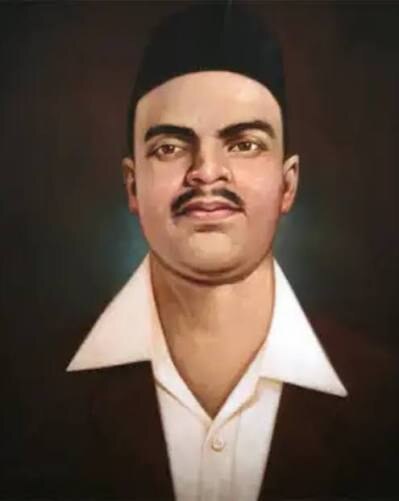
A later painted portrait. Almost all colour images of Rajguru are interpretations made after his death, worked up from the same few photographs.
India in a time of resistance
Rajguru did not appear out of nowhere. He came of age in the single most turbulent decade of colonial rule — a decade in which mass politics rose, collapsed, and left a generation of young Indians looking for another way.
The Rowlatt Act extended wartime emergency powers into peacetime. On 13 April, troops fired on an enclosed crowd at Jallianwala Bagh in Amritsar. For a whole generation, the massacre settled the question of what British rule was.
Gandhi's Non-Cooperation Movement drew millions into political life for the first time — boycotting courts, schools, titles and foreign cloth, and promising swaraj through disciplined non-violence.
After a crowd burned a police station at Chauri Chaura, Gandhi suspended the movement. To many young activists the withdrawal felt like a door closing at the moment it had opened.
The Hindustan Republican Association was founded by Sachindra Nath Sanyal, Ram Prasad Bismil and others — an attempt to organise armed resistance into something with a constitution and a programme.
London appointed a statutory commission on India's constitutional future with seven members and not one Indian among them. The insult was immediate and national.
Why some young Indians turned to revolutionary politics
The revolutionary current of the nineteen-twenties was small — a few hundred committed people at most, against a mass movement of millions. It is easy to misread it as simple impatience. It was not. It was an argument about power, and it had a logic of its own.
Its participants had watched a disciplined, non-violent mass movement gather enormous force and then be stood down. They had seen constitutional petitioning answered with commissions that contained no Indians. They had read about the executions that followed the Kakori case in 1927. They concluded that the colonial state responded to pressure, and that a government which claimed to rule by consent should be made to show that it ruled by force.
That conclusion was contested at the time and remains contested now. Gandhi rejected it outright and never stopped rejecting it. Many nationalists thought it strategically self-defeating. The revolutionaries themselves came to argue, especially in prison, that the bomb and the pistol were of far less consequence than the idea — and that their real work was to make a generation stop believing that British rule was permanent.
A note on how this site treats violence
The events described here include killings. They are set out because they happened and because they carried consequences that shaped Indian history — not because violence is being recommended, admired, or presented as heroic in itself.
A police officer named John Saunders was shot dead at Lahore in December 1928. A head constable, Chanan Singh, was shot during the escape. Three young men were hanged for it in 1931. Each of those deaths was real, and each is stated plainly on this site.
A generation that had been told to wait was being asked, again, to wait — this time by a commission on which no Indian sat.On the Simon Commission's appointment, November 1927
The network he belonged to
In September 1928, revolutionaries from across northern India met at the ruins of Feroz Shah Kotla in Delhi and reconstituted the Hindustan Republican Association as the Hindustan Socialist Republican Association. The added word was not decorative. It committed the organisation to a social and economic programme, not only to the expulsion of the British.
The H.S.R.A. was built as a federated body with a central committee and a separate military wing. Chandra Shekhar Azad, already a fugitive of long standing, was its commander-in-chief. Bhagat Singh, a formidable reader and writer, supplied much of its political argument. Sukhdev Thapar organised in Lahore. Bhagwati Charan Vohra drafted its philosophy. Rajguru belonged to the action side of that structure.
Within the group he was known for what he could do rather than for what he said. He was a marksman, disciplined about physical training, and — by the repeated testimony of those who survived him — almost aggressively unwilling to talk about himself. Where Bhagat Singh left behind essays, letters and a jail notebook, Rajguru left almost nothing at all. The contrast has consequences: it is far easier to write the biography of the man who wrote.
The list below is not a set of profile cards. It is a map of the working relationships that led, in December 1928, to a police headquarters in Lahore — and, in March 1931, to a scaffold.
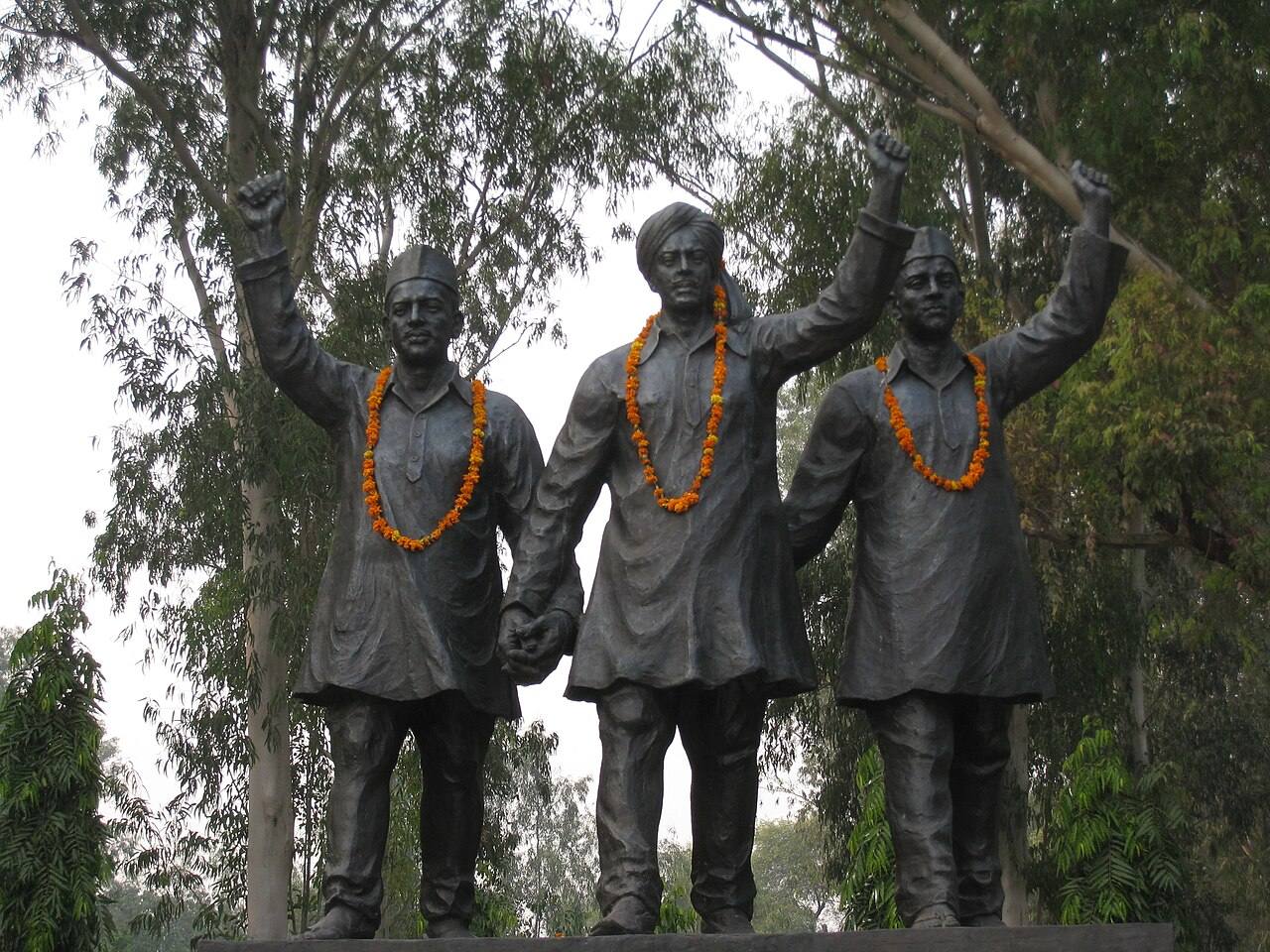
Memorial statues of the three men condemned together in the Lahore Conspiracy Case, garlanded on a day of commemoration.
A defining historical moment
Context
On 30 October 1928 the Simon Commission reached Lahore. A protest march led by Lala Lajpat Rai — one of the most respected figures in Indian public life — met a police cordon. Under the direction of Superintendent James A. Scott, the police made a lathi charge. Rai was struck about the head and chest. He addressed a meeting that evening despite his injuries and died on 17 November 1928. Doctors believed the assault had hastened his death; the government denied a connection.
The H.S.R.A. resolved on a response. The reasoning, stated in its own words afterwards, was that the public beating of a national leader by a police officer was a humiliation that had to be answered in kind, or accepted.
Events
On the afternoon of 17 December 1928, a small team waited near the District Police Headquarters in Lahore. Jai Gopal was posted to identify the target. When a young officer came out and started his motorcycle, the signal was given. Rajguru fired the first shot. Bhagat Singh fired further shots at close range. The officer was John P. Saunders, not Scott. Chandra Shekhar Azad shot dead head constable Chanan Singh, who pursued them, and the party escaped through the grounds of the D.A.V. College.
Consequences
The following day, notices appeared across Lahore over the signature “Balraj”, commander-in-chief of the H.S.R.A. They acknowledged the killing, tied it explicitly to the death of Lala Lajpat Rai, and expressed regret at having had to kill a man while insisting he was part of an order that had to be ended.
The escape from Lahore followed within days, and it worked. Bhagat Singh shaved his beard, cut his hair and left by train dressed as a European-suited gentleman, with Durgawati Devi and her infant son as his supposed family and Rajguru travelling with them as a servant. Rajguru afterwards moved separately through central India. He would remain at liberty for nine and a half months.
Historical significance
The Saunders killing did not, by itself, weaken British rule. What it did was to place the H.S.R.A. — and, within months, Bhagat Singh's arguments — at the centre of Indian public attention. The trial that followed became a political event far larger than the crime, and the executions that ended it turned three young men into the most durable symbols of the revolutionary strand of the freedom movement.
The trial and the imprisonment
What began as a murder investigation became the longest and most politically charged prosecution of the period — and ended with a court that had been created by ordinance for the purpose.
Pune, 30 September 1929
Rajguru was arrested at Pune on 30 September 1929. A pistol and fourteen cartridges were recovered. He had been at liberty for nine and a half months since the shooting at Lahore, moving between safe houses across central and western India.
Testimony from within
The prosecution's case rested heavily on former associates who turned Crown witness — principally Jai Gopal, who had given the signal at Lahore, and Hans Raj Vohra, with Phonindra Nath Ghosh giving evidence on the organisation's structure. Without them the identification evidence would have been far weaker.
Borstal Jail, from 10 July 1929
Committal proceedings opened inside Borstal Jail, Lahore, with twenty-eight accused named. The accused turned the courtroom into a platform: slogans, songs, refusals to rise, and statements addressed past the bench to the newspapers.
June – October 1929
Undertrial prisoners struck for recognition as political prisoners — for decent food, clothing, books and newspapers. Jatindra Nath Das died on 13 September 1929, on the sixty-third day of his fast. His death moved opinion in a way the shooting never had.
Ordinance of 1 May 1930
With the trial stalling, the Viceroy, Lord Irwin, promulgated an ordinance creating a three-judge Special Tribunal empowered to proceed in the absence of the accused, with no appeal except to the Privy Council. The ordinance was made without the legislature and lapsed after roughly six months — but the tribunal's judgment stood.
7 October 1930
In a judgment running to some three hundred pages, the tribunal sentenced Bhagat Singh, Sukhdev Thapar and Shivaram Rajguru to death by hanging. Others received transportation for life or fixed terms; several were acquitted. An appeal to the Privy Council was dismissed in February 1931.
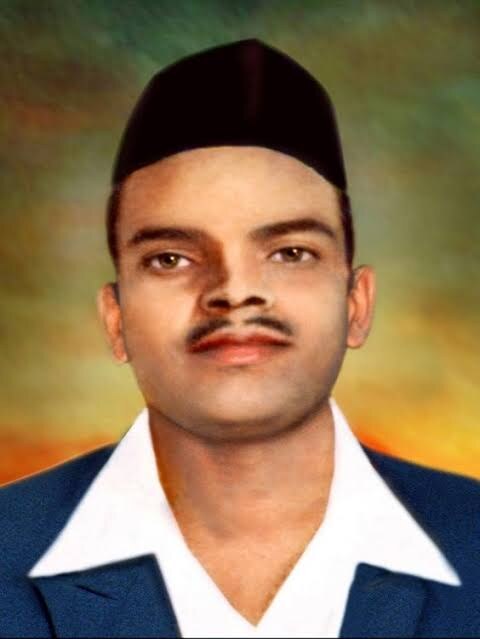
Rajguru was twenty-one when he was arrested at Pune and twenty-two when the sentence was carried out.
23 March
1931
The executions had been fixed for the morning of 24 March. They were carried out instead on the evening of 23 March 1931, at about seven o'clock, inside Lahore Central Jail — brought forward by roughly twelve hours and moved from dawn to dusk, against the ordinary practice, in anticipation of public disorder.
Bhagat Singh was twenty-three. Sukhdev Thapar was twenty-three. Shivaram Rajguru was twenty-two. Contemporary accounts describe the three men walking to the scaffold together and calling out Inquilab Zindabad — “long live the revolution”.
The bodies were not returned to their families. They were removed at night through a breach cut in the rear wall of the jail, carried out towards Ferozepur, and cremated in haste near the village of Ganda Singh Wala on the banks of the Sutlej. The remains were consigned to the river. The site is today the National Martyrs Memorial at Hussainiwala.
Petitions and appeals had continued to the last. Gandhi raised the sentences with the Viceroy during the negotiations that produced the Gandhi–Irwin Pact of 5 March 1931. The commutation did not come. When the Indian National Congress met at Karachi days after the hangings, the executions dominated the session.
The three are almost always commemorated together — a grouping that honours them and, at the same time, has tended to obscure Rajguru as an individual.
- Date
- 23 March 1931 Advanced from the scheduled morning of 24 March.
- Place
- Lahore Central Jail In the Punjab of undivided British India; today in Pakistan.
- Rajguru's age
- 22 years Seven months short of his twenty-third birthday.
- Cremation
- Banks of the Sutlej Near Ganda Singh Wala; commemorated at Hussainiwala, Ferozepur.
How Rajguru is remembered
A town carries his name. A memorial stands on the ground where his family lived. A stamp bears his face. And every 23 March, the country pauses.
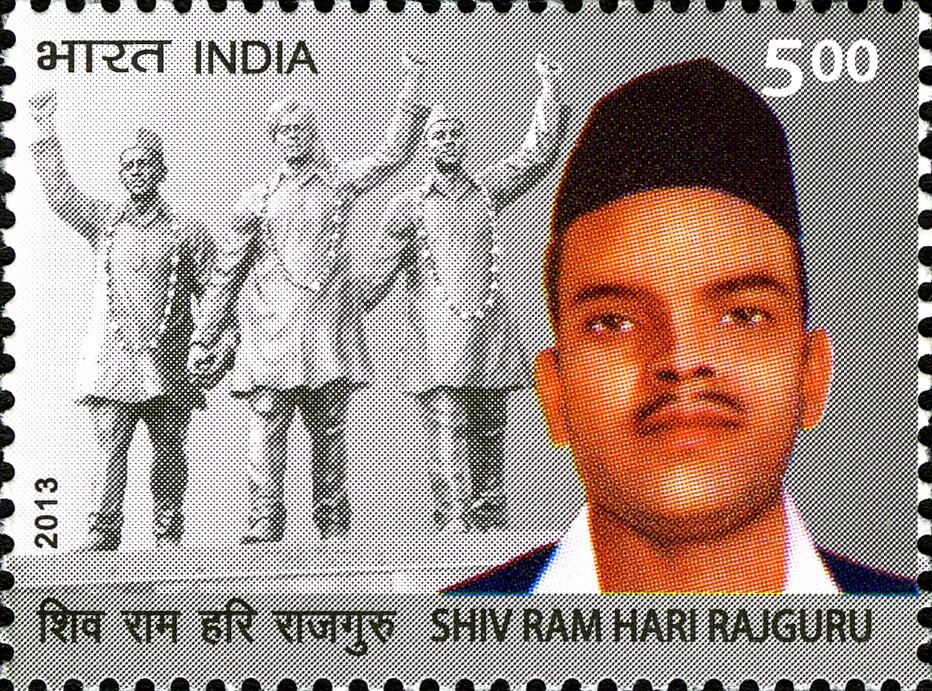
The commemorative stamp issued by India Post in 2013, denominated ₹5 and inscribed “Shiv Ram Hari Rajguru” in Hindi and English.
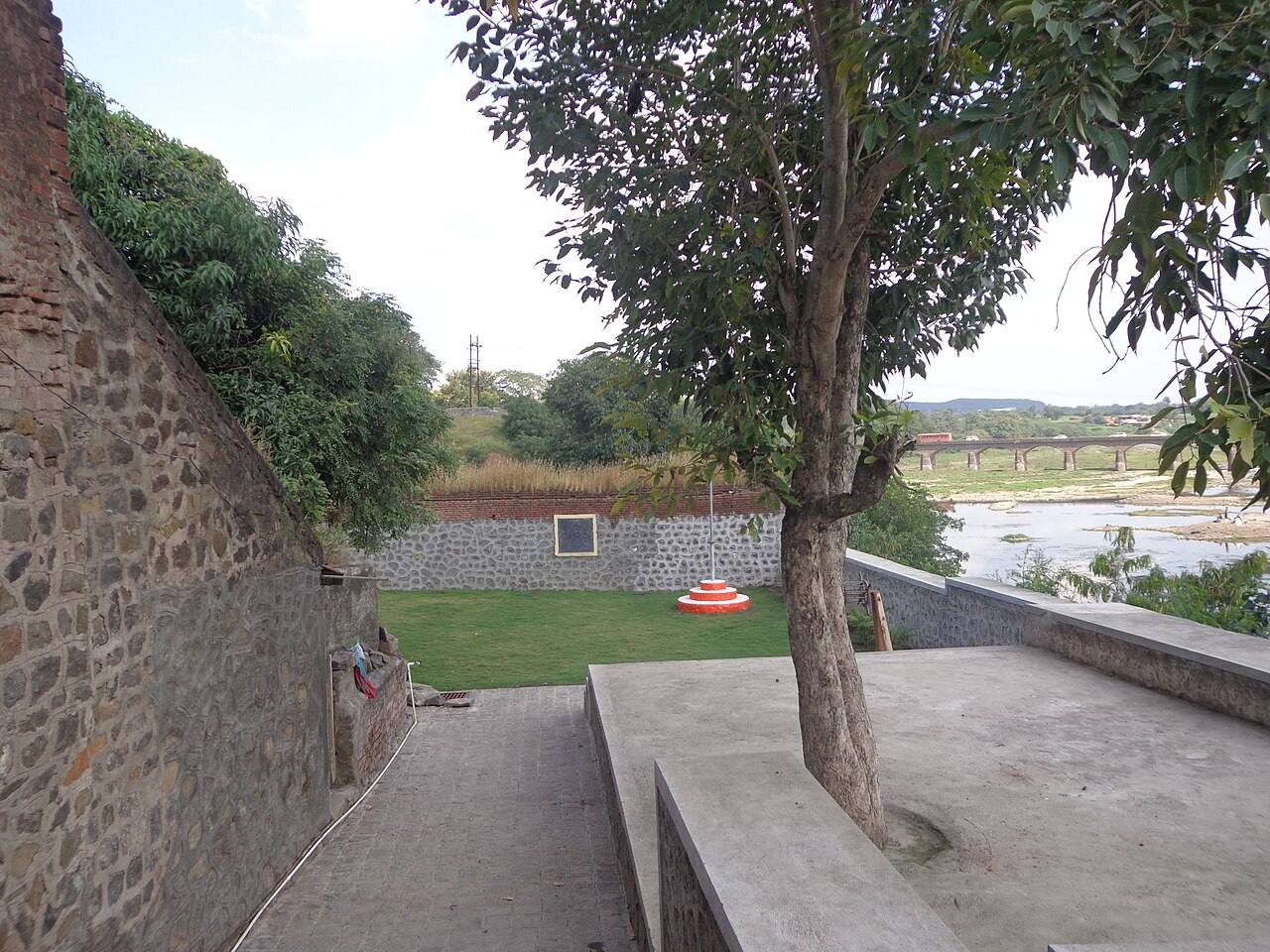
Rajguru Wada, the family's ancestral home at Rajgurunagar, maintained as a memorial on the bank of the Bhima.
The town of Khed, where he was born, was renamed Rajgurunagar in his honour, and the family's ancestral house — the Rajguru Wada, a plot of roughly 2,788 square metres on the bank of the Bhima — is maintained as a memorial. The Hutatma Rajguru Smarak Samiti has hoisted the national flag there each Republic Day since 2004.
In 2013 the Government of India issued a commemorative postage stamp in his name. The University of Delhi's Shaheed Rajguru College of Applied Sciences for Women, at Vasundhara Enclave, carries his name, as does Hutatma Rajguru Mahavidyalaya at Rajgurunagar. The National Martyrs Memorial at Hussainiwala, near Ferozepur, marks the place where the three were cremated.
23 March is observed across India as Shaheed Diwas — Martyrs' Day. It is the single day on which Rajguru's name is most often spoken, and, paradoxically, the day on which he is least often seen as a person. Remembered as one of a trio, he tends to be given the least biographical space of the three. Restoring that space is the purpose of this archive.