Legacy &
remembrance
A town renamed. A house preserved. A stamp, two colleges, a memorial on a riverbank, and a national day of remembrance shared with two other men. This is what became of the name after 23 March 1931 — and what it is still being asked to carry.
- Birthplace
- Renamed Rajgurunagar
- Memorial house
- Rajguru Wada
- Cremation site
- Hussainiwala, Ferozepur
- Postage stamp
- India Post, 2013
- Observed
- 23 March · Shaheed Diwas
One day a year, and the shape it gives him
23 March is observed across India as Shaheed Diwas, Martyrs' Day, on the anniversary of the executions at Lahore. Flags are lowered at memorials, wreaths are laid at Hussainiwala, schools hold assemblies, and the names of Bhagat Singh, Sukhdev Thapar and Shivaram Rajguru are spoken together across the country.
The trio is the unit of memory. It is how the three appear on the stamp, in the statues, in the school textbook paragraph and in the film. That grouping is historically accurate — they were tried together, condemned together and hanged together — and it does something to Rajguru that is worth naming plainly: it makes him the third name.
Public memory in India has given Bhagat Singh a biography, a body of thought and an argument. It has given Sukhdev an organisational role and a set of letters. It has given Rajguru an act and a date. He is remembered constantly and examined rarely.
None of this is a complaint about the commemoration. It is an observation about how commemoration works: it preserves what is easiest to hold, and what is easiest to hold is what was written down.
Where his name is on the ground
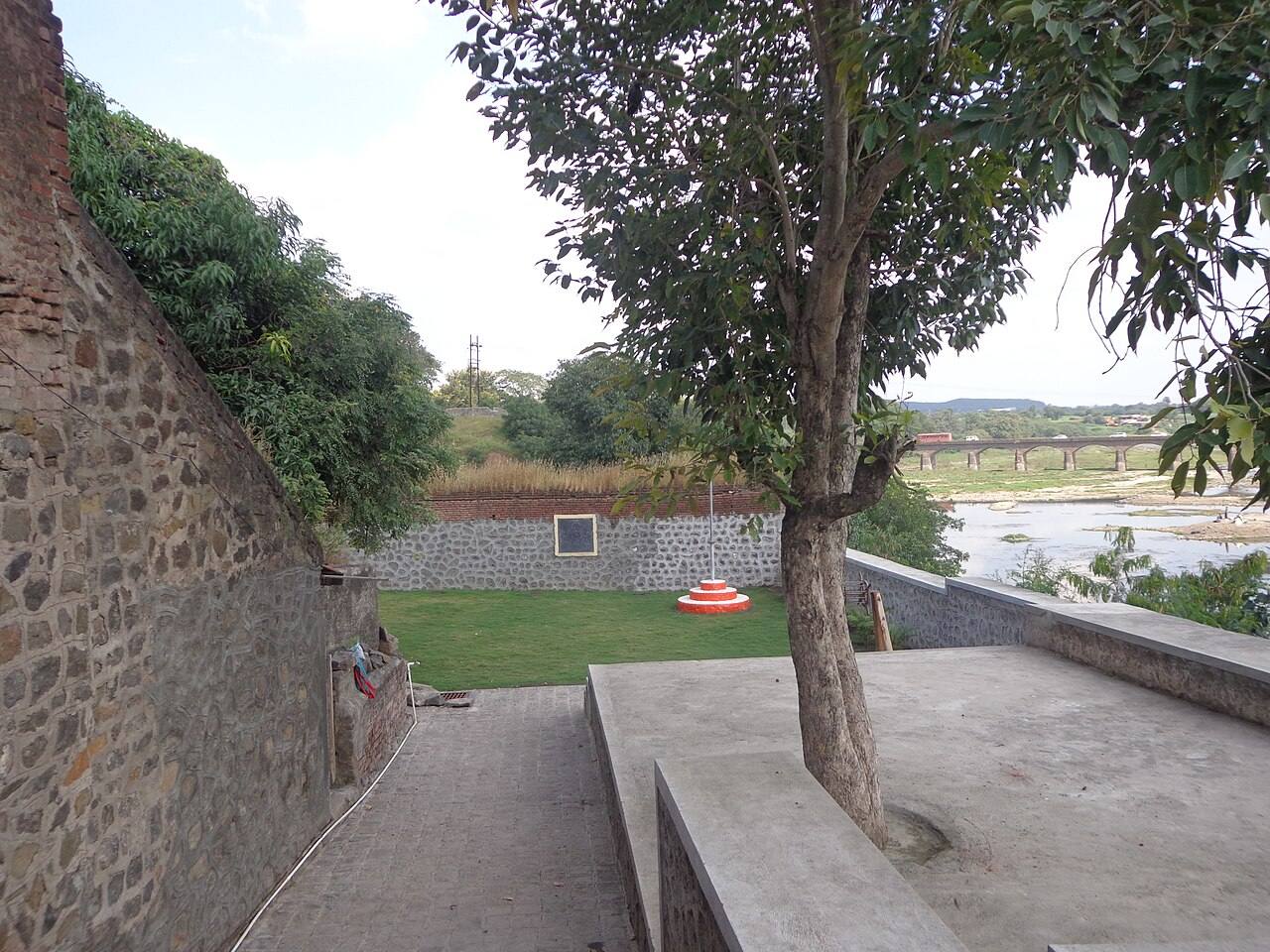
Rajguru Wada, Rajgurunagar. The site of the family's ancestral house, on the bank of the Bhima, with the river and road bridge visible beyond the wall.
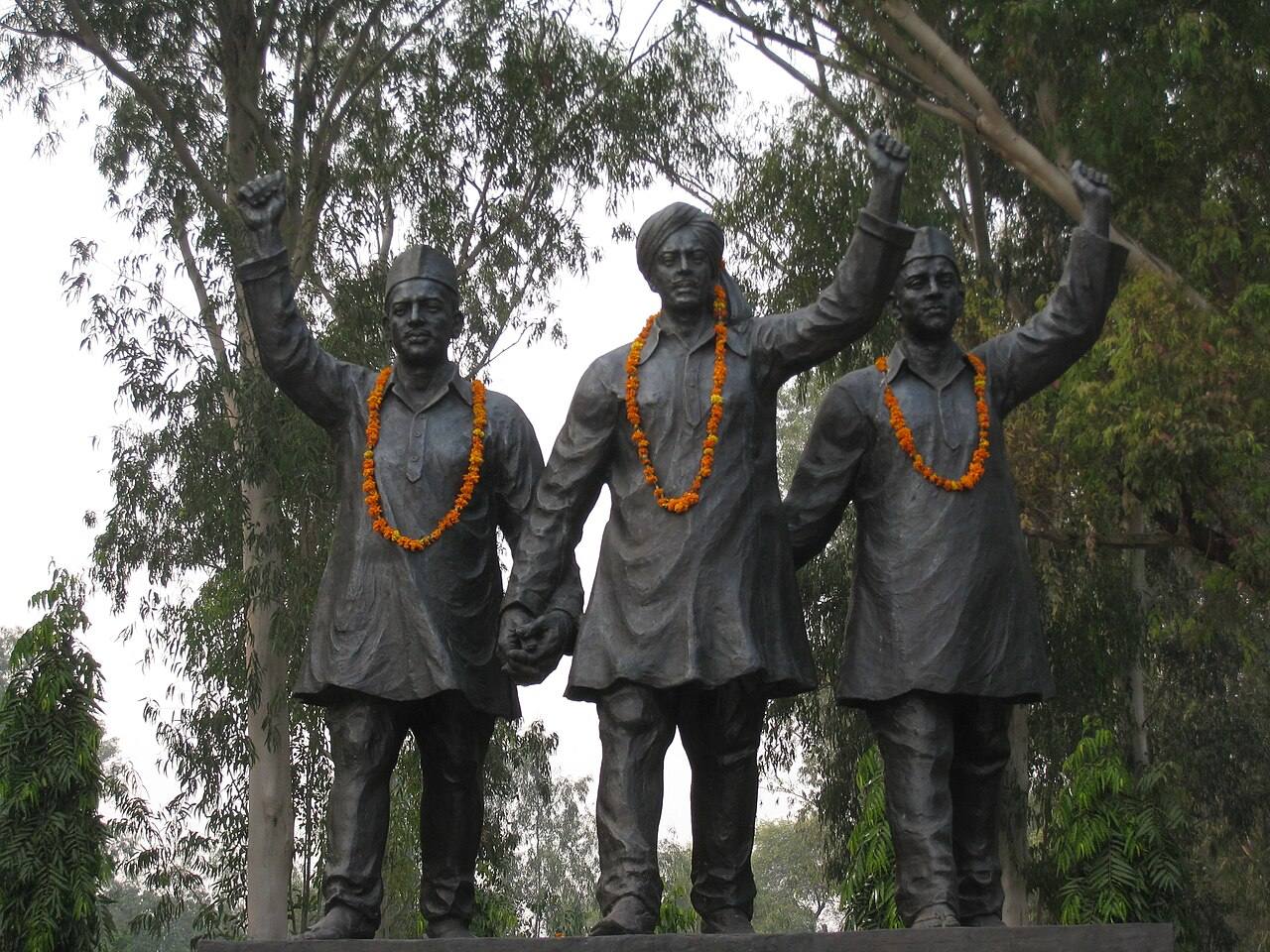
The memorial group of the three martyrs, garlanded on a commemorative day.
Rajgurunagar — the town that took his name
Khed, in the Khed taluka of Pune district, was renamed Rajgurunagar in his honour after independence. Both names remain in local use — the taluka is still Khed — and the town today is an ordinary market and administrative centre on the road north from Pune, which is precisely what makes the renaming meaningful: his name is attached to a working place rather than to a monument.
Rajguru Wada — the ancestral house
The family's ancestral home, a plot of roughly 2,788 square metres on the bank of the Bhima, is maintained as a memorial. The Hutatma Rajguru Smarak Samiti has hoisted the national flag there each Republic Day since 2004. It is the only site directly associated with his own life that a visitor can still stand in.
The National Martyrs Memorial, Hussainiwala
Near Ferozepur, on the banks of the Sutlej close to where the three were cremated in the early hours of 24 March 1931, stands the National Martyrs Memorial. It is the principal site of national commemoration on 23 March, and it is roughly a thousand kilometres from the house he was born in.
Statues, roads and public sites
Statue groups of the three martyrs stand at memorial sites in Punjab, Haryana, Delhi and elsewhere, and roads and public buildings carry Rajguru's name in a number of Indian cities. The statues almost always show the three together, arms raised — a composition that has become the standard visual formula for the case.
The name in institutional use
Colleges
The University of Delhi's Shaheed Rajguru College of Applied Sciences for Women, at Vasundhara Enclave, is a constituent college named for him. In his own district, Hutatma Rajguru Mahavidyalaya at Rajgurunagar carries the name in Marathi — hutatma, martyr.
There is something fitting in both. A boy who could not finish his own schooling has his name on institutions that exist to let other people finish theirs.
The 2013 postage stamp
In 2013 the Government of India issued a ₹5 commemorative postage stamp inscribed “Shiv Ram Hari Rajguru” in Devanagari and Roman script. The design places his portrait — worked up from the single surviving photograph — against a monochrome image of the memorial statues of the three martyrs.
It is a small object and a significant one: a stamp is the state's own statement about who belongs in the national story, issued in his name alone rather than as part of a trio.
Textbooks and syllabuses
Rajguru appears in school history curricula across India within the treatment of the revolutionary movement and the Lahore Conspiracy Case. The treatment is typically brief — a sentence or two inside a paragraph on Bhagat Singh — which is the point at which this archive tries to be useful to teachers.
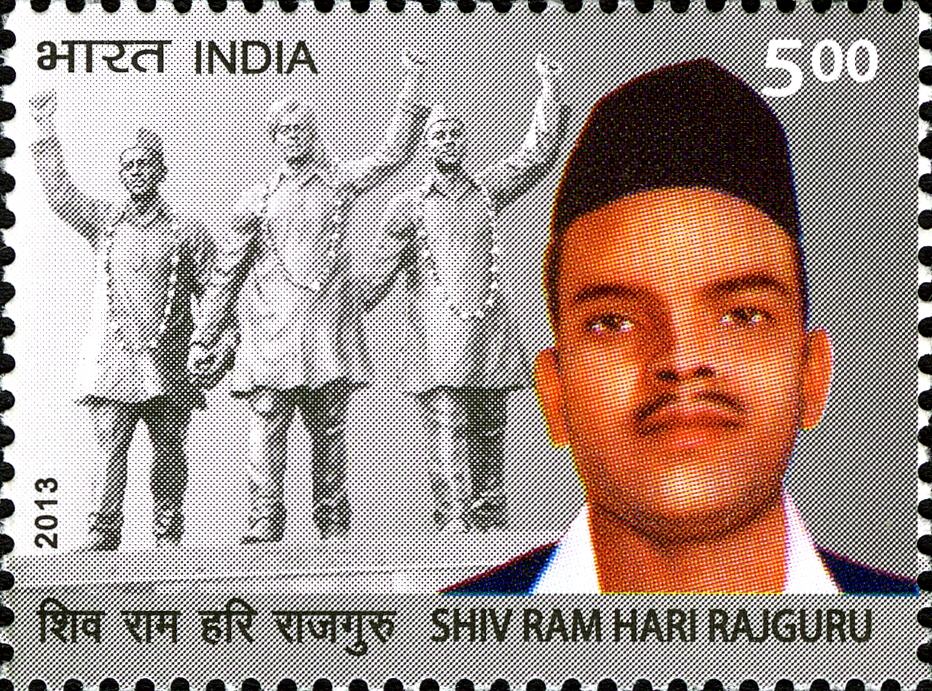
The 2013 India Post commemorative stamp, ₹5, inscribed “Shiv Ram Hari Rajguru”.
On screen, and on the page
Indian cinema
The Lahore Conspiracy Case has been dramatised repeatedly in Indian cinema, from Shaheed (1965) through The Legend of Bhagat Singh (2002) and 23rd March 1931: Shaheed (2002) to Rang De Basanti (2006), in which a group of contemporary students perform the revolutionaries and find the parallel closing on them.
In nearly all of these, Rajguru is a supporting character: present, loyal, physically capable, and given comparatively few lines. Film follows the same logic as memory. The man who left no words is hard to write dialogue for, and so he is written as action.
He also appears in Marathi and Hindi popular literature, in commemorative pamphlets, in school pageants, and in a large body of unsourced material online. That last category deserves particular caution: a great many quotations circulate under Rajguru's name that cannot be traced to any contemporary source.
Historical scholarship
Serious scholarship on the H.S.R.A. has grown considerably since the nineteen-seventies, drawing on colonial intelligence records, court papers, the memoirs of surviving members such as Shiv Verma and Bijoy Kumar Sinha, and the collected writings of Bhagat Singh. The trend of that work has been to take the revolutionaries seriously as political thinkers rather than treating them as a romantic footnote to the Congress narrative.
Rajguru remains the least served by this literature, for the reason given throughout this archive: he is the subject of documents rather than their author. Any future advance in what can be said about him is likely to come from Maharashtra — from local records, family recollection and the Varanasi years — rather than from the Punjab archives that have dominated the field.
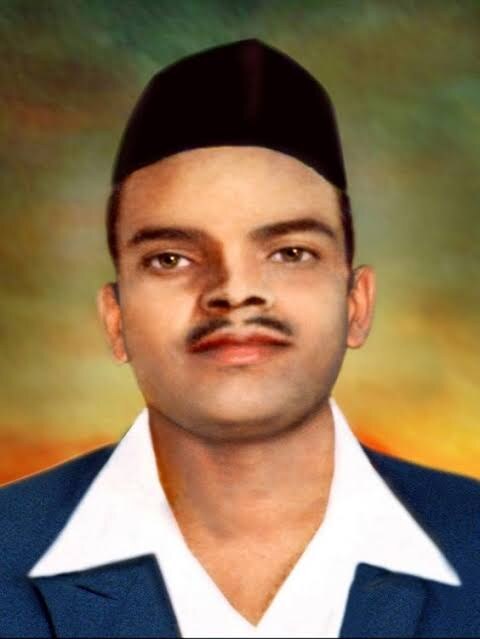
A colourised interpretation of the surviving photograph, of the kind widely reproduced in commemorative material.
A note for readers and students
Quotations attributed to Rajguru circulate very widely on social media and on quotation websites. This archive contains none of them, because none can be traced to a contemporary source. If you are writing about him for school or university, treat every such quotation as unverified unless the person offering it can name where it was recorded.
Where he belongs in the larger story
- Scale
- A few hundred The revolutionary movement was tiny beside a Congress that mobilised millions. Its significance was never numerical.
- Effect
- Political shock The trial and the executions produced a wave of mobilisation, especially among students and young workers.
- Cost
- The organisation Within three years of its founding, the H.S.R.A.'s leadership was dead or imprisoned and the body itself was finished.
- Legacy
- An argument That independence should be social and economic as well as political — a claim that outlived the men who made it.
The honest assessment is neither the textbook sentence nor the poster. The revolutionaries did not win independence; the mass movement, the war, the mutinies of 1946 and the collapse of British capacity did that. What the revolutionaries did was to make a particular argument impossible to ignore — that colonial rule was not a legal order to be petitioned but a power to be broken, and that what replaced it should be judged by what it did for the people at the bottom.
Rajguru's part in that was direct and specific. He was not its theorist. He was one of the people who made the argument audible, at the cost of his life and of two other lives that also mattered.
Why Rajguru's story
still matters
Not as a lesson to be recited, but as a set of questions worth keeping open.
History was made by people younger than the students who study it
Rajguru was twenty at Lahore and twenty-two when he was hanged. Bhagat Singh and Sukhdev were twenty-three. Jatindra Nath Das was twenty-four when he died on the sixty-third day of a fast. The freedom struggle is usually taught as the work of elder statesmen; a great deal of it was the work of people who had not finished their education.
What it costs to act on a belief
Whatever one concludes about the method, the men in the Lahore dock knew what they were risking and did not ask for it to be reduced. That is worth understanding carefully rather than admiring vaguely — including the part where a mistaken identification meant that the man they killed was not the man they meant to kill.
What happens when a government writes its own court
Ordinance III of 1930 created a tribunal for a single prosecution, allowed trial in the absence of the accused, and closed off ordinary appeal. The question of what distinguishes a legal process from an administrative one, and who decides, did not stop being interesting in 1931.
Who gets remembered, and why
Rajguru is remembered less than his comrades because he wrote less. That is a fact about archives, not about the man. Learning to notice it — to ask who left records and who did not — is one of the most transferable skills a student of history can acquire, and it applies to every subject, not only this one.
The freedom movement was an argument, not a chorus
Gandhi and the H.S.R.A. wanted the same thing and disagreed profoundly about how to get it, in public, at length, and in good faith. A history that flattens that disagreement into a single patriotic narrative is not honouring anybody; it is removing the part where people had to think.
Independence was the beginning of the question
The word the H.S.R.A. added to its name in 1928 was “socialist”, and it meant that removing the British would not by itself be enough. Whether that was right, and what it would look like now, is a live question rather than a settled commemoration.